'%3e%3cpath%20d='M490.667%20234.667H21.3333C9.55126%20234.667%200%20244.218%200%20256C0%20267.782%209.55126%20277.333%2021.3333%20277.333H490.667C502.449%20277.333%20512%20267.782%20512%20256C512%20244.218%20502.449%20234.667%20490.667%20234.667Z'%20fill='black'/%3e%3cpath%20d='M490.667%2085.3335H21.3333C9.55126%2085.3335%200%2094.8848%200%20106.667C0%20118.449%209.55126%20128%2021.3333%20128H490.667C502.449%20128%20512%20118.449%20512%20106.667C512%2094.8848%20502.449%2085.3335%20490.667%2085.3335Z'%20fill='black'/%3e%3cpath%20d='M490.667%20384H21.3333C9.55126%20384%200%20393.551%200%20405.333C0%20417.115%209.55126%20426.667%2021.3333%20426.667H490.667C502.449%20426.667%20512%20417.115%20512%20405.333C512%20393.551%20502.449%20384%20490.667%20384Z'%20fill='black'/%3e%3c/g%3e%3cdefs%3e%3cclipPath%20id='clip0_209_292'%3e%3crect%20width='512'%20height='512'%20fill='white'/%3e%3c/clipPath%3e%3c/defs%3e%3c/svg%3e)
15.03.2026
MARCH 15 – CHARITY DAY WITHIN THE NAURYZNAMA
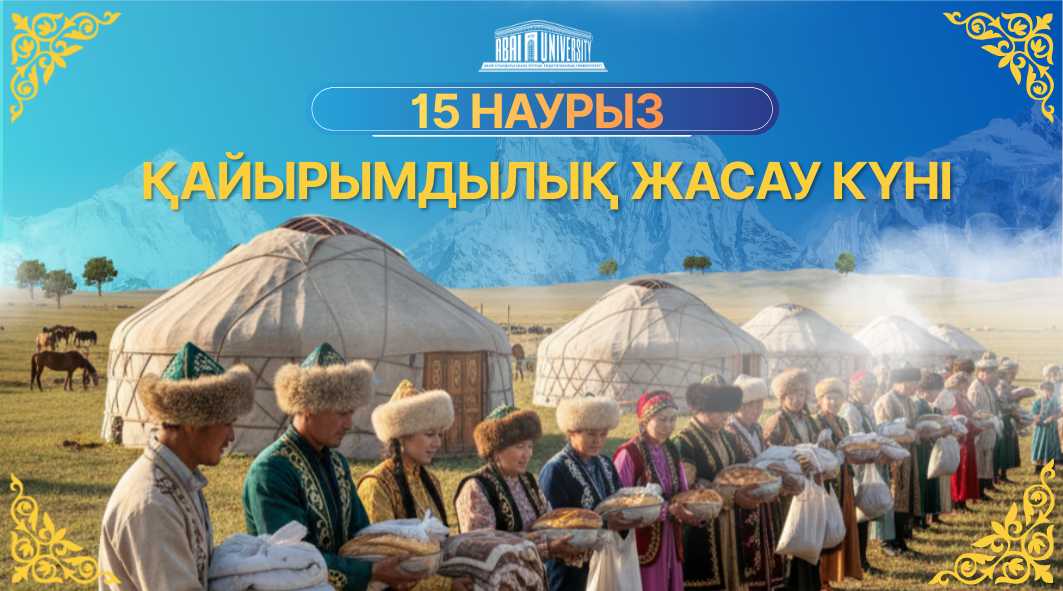
March 15 marks Charity Day as part of the Nauryznama decade. This is a special day dedicated to celebrating mercy, harmony, compassion, and kindness. In the Kazakh worldview, charity is perceived not merely as material assistance, but as a profound ethical norm and a moral duty. Following the principle "Being generous leads to no lack," our ancestors never left one another alone in times of hardship.
Helping those in need, caring for people with disabilities, and cherishing the elderly are considered the moral obligations of every citizen. Each form of charity in the national context reflects the solidarity and brotherhood of our people. For instance, the traditions of "Asar" and "Ume" involved the entire village voluntarily completing large-scale tasks. Meanwhile, "Zhylyu zhinau" referred to the collective contribution of livestock or property to help a family that suffered a major loss due to fire or natural disaster.
A subtle example of social support is the "Nemeurin" custom. According to this tradition, newly married couples facing financial hardship would visit relatives and use subtle hints to express what they needed to establish their household. The "Kyzyl koteru" custom was practiced when a poor person lost their only cow or mare; in such cases, 12 close relatives would gather to replace the lost animal.
Hospitality and blessings (bata) also hold a special place as symbols of spiritual generosity. Treating any traveler as a "guest of God" (Kudayi konak) is the law of the steppe. We consider the blessings of elders to be a manifestation of goodwill that transcends material wealth. Additionally, religious obligations such as Zakat and Fitr help bridge the gap between the rich and the poor, increasing social responsibility.
The fruits of these deep-rooted traditions are visible in global statistics. According to the Charities Aid Foundation (CAF) World Giving Report 2025, Kazakhstan ranked 30th in the world charity rankings. Research shows that residents of the country spend an average of 1.2% of their income on charity. In this regard, Kazakhstan has surpassed developed nations such as the USA, the UK, and Germany. Our country also leads in the post-Soviet space and Central Asia, performing significantly higher than Ukraine (0.98%), Moldova (1.12%), and Azerbaijan (0.75%).
At the initiative of Kazakhstan, the UN has declared 2026 as the International Year of Volunteers. This decision highlights Kazakhstan's active stance in developing the volunteer movement. Abai University is no exception to this trend. The university hosts numerous charitable organizations that support people with disabilities and those in need, with thousands of students as members. These students implement socially significant projects, providing both material and spiritual support while fostering a culture of student volunteerism across the republic.
A kind word to the heavy-hearted, showing compassion to the elderly, keeping the environment clean, or participating in volunteer projects—these are all the beginnings of great virtue. This day in the Nauryznama decade calls us to share not only material wealth but also the warmth of our hearts. After all, charity is the golden foundation of our national identity.
Abai University Media Center
